.
 |
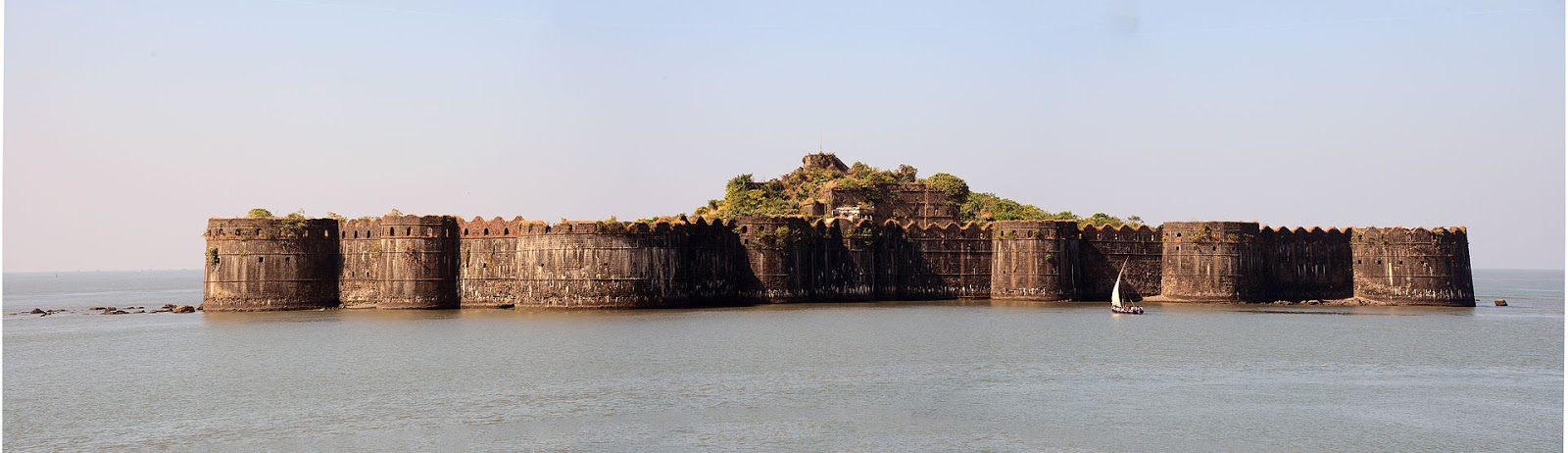
Fort Janjira/Jaldurg In The Middle Of The Arabian Sea. (Picture courtesy:
|
|
We had been to Maharashtra, a few months back and visited many forts over there. The best and unique fort was the Janjira Fort which is also called Jaldurg. 'Janjira' is an Arabic word for island, it seems. It is situated in the port town of Murud, a small sleepy town, facing the Arabian sea. The boat ride to the fort was OK but getting down at the small entrance to the fort was difficult. They charge Rs.600 for the boat ride without any receipt. My son insisted for the receipt and then they gave. Parking fee was Rs.40 at a dirty area. Again no receipt. We need lot of patience to cross the narrow village roads to the jetty. But the boatmen were good. We gave them Rs.200 extra since the next day was Ramzan! This is mainly a Muslim area. We saw goats tied to the gates in each and every house. The people were busy feeding them some greens. The guide charged Rs.400. He was OK.
Wiki says: Janjira is considered one of the strongest marine forts in India. The fort is approached by sail boats from Rajapuri jetty. (Murud is 165 Kms. south of Mumbai).
The main gate of the fort faces Rajapuri on the shore and can be seen
only when one is about 40 feet (12 m) away from it. It has a small
postern gate towards the open sea for escape.
The fort has 26 rounded bastions, still intact. There are many
cannons of native and European make rusting on the bastions. Now in
ruins, the fort in its heyday was a full-fledged living fort with all
the necessary facilities, e.g., palaces, quarters for officers, mosque, temple,
two small 60-foot-deep (18 m) natural fresh water lakes.
A special attraction of this fort is, 3 gigantic cannons named Kalalbangdi, Chavri and Landa Kasam. These cannons were said to be feared for their shooting range.
This link says:
Janjira came
into prominence in the late 15th or early 16th century when the Siddis
became its virtual masters. After it had been ruled over by such
historical greats as the Mauryas, Silharas, Chalukyas, and Yadavas, it
fell into the hands of the Abyssinians or Siddis in 1490 A.D, by way of
trickery against a Koli king. Malik Ambar, a powerful Abyssinian,
subsequently constructed a strong stone fort there in 1567 A.D. Numerous
wars were waged against the Siddis by the Marathas, Mughals, and
Portuguese to wrest Janjira from them, but in vain. The Siddis proved
fiercer soldiers and greater seafarers than them all. The Janjira state
came to an end after 1947 with the merging of princely Indian states
with the union.
Shivaji also waged a war against the Siddis but couldn't penetrate the fort. His son Sambhaji also tried. Built Padmadurg fort nearby and tried to come inside this fort via a tunnel under the sea, but in vain. Now also they say that there is a tunnel from the fort to the Rajapuri town.
They had an active market area inside the fort. They had a full-fledged town. The descendants have fled to Indore and Mumbai later, it seems. Some dark skinned people were seen in the town of Rajapuri here... the result of mixed marriages!
Our guide said that the Fort took 22 years to build
and is spread over 22 acres of land. At the entrance is an inscription
in Persian language and a stone carving depicting a tiger engulfed by six
elephants which, is the emblem of the might of the
Siddis, it seems.
He said that the queen had a 2 storied glass palace and
bath with water channelled from streams. We saw the dry toilets for the queen.
About Siddis:
The Siddis are
the descendants of slaves, sailors, and maritime workers, forced and
voluntary migrants from the East African countries of Somalia, Ethiopia,
Sudan, and later Zanzibar. The forced migration of Africans for purposes of slavery is
incontestably the major reason for the presence of Africans in India.
 |
| The sleepy town of Murud from where we can reach the Fort. |
 |
| The narrow entrance to the fort. Slippery, broken steps. We have to be
very careful while getting down from the boat and climb the steps
(nothing is there there to hold the boat or us, boatmen have to help us and
hold the boat too!). This is the only entrance for people to enter the fort which is not easy to locate unless you know the place. We can reach here only by boats. |
 |
| This picture was taken by my son from the topmost point at the Janjira fort. Click on the picture to have a good view. You can see the sweet water pond on the left. |
 |
| Sweet water pond inside the fort. The whole Janjira town people were using this water for drinking and cooking purposes. One more lake was on the other end of the Fort. Water was available throughout the year, it seems. |
 |
| The inside of the fort..The weeds are removed during the peak tourist season, it seems. The ruined building had seven stories which was Siddi leaders' offices! |
A special attraction of this fort is, the 3 gigantic cannons named Kalalbangdi, Chavri and Landa Kasam. These cannons were said to be feared for their shooting range. They are in the picture shown above.
 |
| The 40' high walls of the fort. The fort was made of stones bonded together by a mixture of lead, sand and gul. Wiki says so. What is gul? Or is it gud, jaggery? Anybody knows? It cannot be rose flower! |
 |
| This picture was taken from the top of the fort. Stones can be seen
near the wall. No other entrance anywhere else, except a small hole on the
other side of the fort which was crude. |
 |
| The small escape route on the opposite side of the main gate. Imagine Siddis going out via this tiny opening! Posted this picture on 5th April, '16 |
 |
| Shivaji's son, Sambhaji built another sea fort in 1676, known as Padmadurg or Kasa fort, to challenge Janjira and failed. This picture of the fort was taken from the Janjira fort. |
 |
| Another picture of the oval shaped Janjira Fort |
The Maharashtrian tourism Department has got a treasure in their hands. If this unique fort was somewhere in Europe, they would have maintained it very well which would have attracted more tourism to the area. I might forget our visits to the other forts but not this one!
We reached the fort by sail boat and while returning, a motor boat came and pulled our boat against the wind direction to the shore!
If anyone know more details of the place, please write in the comment section, please. Thank you!
P.S.: I came across this You tube
link now, and you can see the fort without the weeds!
.
Edited on 29th May, '16: Came across this article on
'African rulers of India'. Very interesting!
Post updated on 14/6/20:
African rulers of India
.








.jpg)
